Category Archives: Past Event Reports

Report of TD SIG Forum @ JALT2025

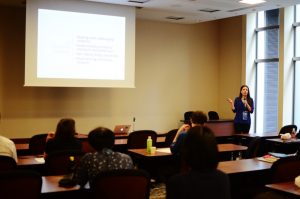
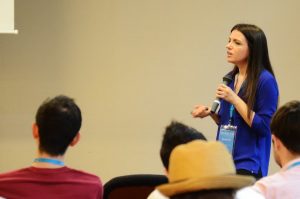
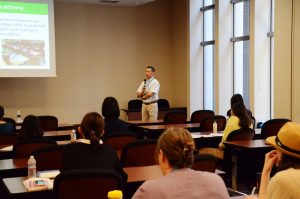
This year’s Teacher Development SIG forum at the JALT international conference in Tokyo was a success. As has been the pattern in the last few years, the forum followed a workshop format which allowed sessions to be interactive, guiding participants down a journey of development. Not only did our three workshop leaders engage participants with thought-provoking content, but the topics and tasks created a sense of pragmatic application.

For the first session on podcasting, Matthew Turner led us down a path of authentic practice wherein we learned that decision-making and speech choices about content and flow can deviate from what we initially intend. Moreover, a podcast roleplay interaction with participants showed how reasoning or argument might lead to critical topic points but often give way to personalities and idiosyncrasies – especially our own! Plenty of insights were gained, from authentic takes on podcasting planning to purposeful ways of managing the ebb and flow of discussion points.

For the second session, John Rucynski led us down a path of discovery about introversion. Participants got to hear and discuss teaching experiences related to introverted or extroverted personalities, as well as implications for teaching environments. Further, we learned that the fine line between what is labelled as introversion and what people actually claim as their own introverted qualities can be blurred. Though our work within EFL contexts may push us to become the ‘ideal’ teacher, if introverts welcome their introverted ways, it is possible to bring a power of balance. One’s introversion can become akin to the traditionally revered ‘extroverted one’, whether planned or not.

For the final session, Sajjad Pouromid introduced an important take on listening and listening assessment. Participants engaged in role plays using prompt cards to monitor and reflect on listenership behaviors such as body language, backchanneling, eye contact, and response timing. The session moved beyond listening as comprehension to highlight the communicative value of active listenership. Through a personal anecdote and group discussion, attention was drawn to the gap between what is valued in tests and what matters in real conversations. The session offered practical insights into raising awareness of listenership in language teaching and assessment.

Our 10-12 participants enjoyed an intimate development forum and each expressed the enjoyment and usefulness of the forum. We are looking forward to hearing your journey of development and seeing you soon!

Review of TD SIG Forum @ PanSIG2025

It was a small, intimate vibe at the gathering of the Teacher Development SIG Forum late on a rain-swept Saturday on the Kanda University International Studies campus for PANSIG 2025. The morning had started strong with a thorough presentation from Dr. Johnmarshall Reeve on facilitating autonomy-supportive teaching, agentic engagement, the importance of invitational language, and success as defined as ‘thriving’. It was great to see in the TD SIG’s two presentations some of Reeve’s key themes become actualised in real time and in workshop form. This forum happened to be the only workshop-style session I attended that weekend, reflecting that TD is all about developing through doing and, most importantly, doing together. A feeling of togetherness seems to be at the heart of the SIG and, as it turns out, autonomy-supportive teaching.

Throughout her presentation “Developing Teacher Autonomy Through Reflective Practices: Intersubjectivity and Communication”Joan Kuroda spoke effervescently about her love of mentorship training (and what it could do for autonomy), shared reflection, and John Dewey (whom she dubbed “the godfather of reflection”). Behind all of this, sometimes explicitly stated but deeply imbedded, was a deep respect for the chance of learning, developing through recognising mistakes, and vulnerability. Evident throughout her talk was a study of reflective practices, being ensconced in approaches such as Mac Van Manen and hermeneutic phenomena. However, she said she was tired of only studying about this and how for the last couple of years, it had truly been time to “get going” with reflective practice. She detailed her experiences with a small reflective group of educators, which I later learned had morphed over time but was happily charging along in a very intentional and purposeful way. At the heart of her presentation was an incident about three high-energy boys, seemingly off-task and overly jocular in a classroom that was otherwise on point. The crux of the issue, however, was being addressed with the possibly over-familiar diminutive ‘-chan’, which caused the teacher quite a bit of distress. Taking a phenomenological approach to analyse this incident, the reflective approach used begins with a teacher collecting data about an incident, creating a narrative about it, and then beginning a line-by-line analysis of this narrative in what Joan called a “crafted story”. The word choice here is key- it is not a retelling or description of events: it is a creative act and what Joan called “the making and re-making of reality”. Reflection is not a one shot and you’re done act- it is built on the foundation of plausibility, a “suspension of judgement”, empathy (with the students and with other teachers), and it is a creative act defined collectively.
 
The small groups of reflecting teachers were then further guided to wonder about what might have been happening in that classroom, what could the teacher do, and the teacher’s own decision for what could be done. In our own particular group, we spoke of the possibility of under-challenged students, why some teachers have thicker skin than others, why this seeming incident of disrespect would be bothersome (or not even disrespectful) to some teachers and not others, and the likely previous experiences some students had with ALTs. It was curious to hear that, in the end, the teacher approached the students directly to find out about the issue, which was a student desire to be closer to the teacher. As it also turns out, following on from this chat with the students, the classroom rapport and performance was enhanced. I would have loved to enquire more about the wording of that chat with the students, for I assume that it involved quite a lot of emotional vulnerability on the part of the teacher in admitting his/her taking offense at the use of the diminutive. I also wondered about the value of reflecting ‘what if’ and ‘what could’ (phrases Joan instructed us to use when attempting our own reflections) if you could just get the ‘real’ answer straight from the students’ mouths. However, while Joan did not say this explicitly, I’d like to think that the process of collective and reflective exploration of events (with other teachers prior to consulting the students) prepared the teacher for open-minded discussion and for a potential answer that a student may give. In a word, it gave the teacher the confidence to be vulnerable in a safe space with other teachers first and thus hopefully recreate that safe-space with the students in a similar conversation.
 
Later in the session, Joan and I wondered about how often teachers do the tasks that we ask of students, and we agreed that the frequency is probably a lot lower than we would like to admit. I also asked Joan why she insisted that this reflective process had to be about a ‘problem’, rather than a win. Joan contended that you could use this process for wins, however it was problems that brought about vulnerability, and it is vulnerability that brings teachers together, which is the training ground for bringing teachers and students together. In this sense, this reflective practice linked back nicely to Reeve’s contentions in the morning session about how, in an autonomous supportive environment, more invitational language is needed (‘you may want to/ you could’, as opposed to ‘you must/you should’) and also, that it is equally important, if not more important, for the students to reflect on their autonomous actions with each other, as compared to explaining their autonomous decisions to the teacher.  Autonomy is an act defined by sharing with equals. It was here that I was very much reminded of the first TD SIG Forum I attended at JALT 2023, in which current TD President Jon Thomas gave a deeply personal talk about how, in the classroom, there is no ‘them and me’ when it concerns the teachers and the students, despite how often teacher-talk contains notions about how ‘they’ (the students) didn’t get it. It was a truly motivational speech, so it was great to see some of these unifying themes come together in a TD Forum once again.

The proceedings then moved from reflecting collectively to creating collectively with Anthony (Chuck) Glovia’s “Lyrics as Language: Collaborative Songwriting for Expressive Agency in the Classroom”. Chuck opened the presentation with the think-pair-share on the question “Why do lyrics stay in our memory?”, before outlining the agentic elements of creating music in class. Namely, he highlighted how students choosing lyrics demonstrated an expressive side of autonomy, the cultural agency of choosing themes, and also how the performative element in lyric creation demonstrated linguistic competence. This was a great verbalisation of some of the agentic themes of the conference, but it was the subsequent stages that made for an interesting experience. After demonstrating a sample 3-line verse song in a blues format, Chuck then had TD attendees gather into small groups to make a similar song. Themes were suggested and attendees were invited to collaboratively create a 3-line verse. Thus, we are returned to the former question concerning how often teachers do what they ask their students to do. What followed revealed some curious sensations about creativity, anonymity and collaboration. It felt far easier to create the 3 line-songs as a group than individually. As a group, the sense of pressure and accountability seemed far less, even though we all contributed one line.  This reminded me of the plenary session in the morning; in a brief comment, Reeve talked of the value of anonymity in autonomy when asking for student feedback via apps such as Mentimeter. The notion of anonymous autonomy was implied in this lyric creation act, and I would have liked Chuck to explore ideas how creating music in class could be both authentically agentic, equally anonymous, and potentially more free of anxiety for language learners when creating a ‘performer’ identity.
 
What was equally interesting was how, mid-presentation, Chuck was directly challenged with a question about why we were doing this (a question that could be aimed at why would students do this activity and also why as teachers we were we doing that right then). I found this fascinating for three key reasons. Firstly, I would like to think that the TD is a SIG that has effectively created an atmosphere where teachers feel comfortable challenging one another. Secondly, this moment also brought me back to another key point from the plenary session of the morning. It was so refreshing to see Reeve stipulate the benefits of explicitly stating why students are being ‘invited’ to do something, something I have always felt is vital to purposeful learning. Thirdly, even if I felt that Chuck had actually stated the ‘why’ of the activity, I loved the fact that it was asked again and that it could be answered again. As a matter of fact, I would be happy to be asked that question every 10 minutes in a lesson, as if to keep the raison d’etre of all learning alive and burning and always in our minds.

Some 10 minutes into the session, after the songs were made, there was sadly no time to share them despite attendee desire to do so. I would like to share the lyrics that were made in our group for a couple of reflective reasons. The stanza went a little something like this:

It’s so hard to make a decision (I chose my clothes today)
I can’t make a decision to save my life 
So I’ve decided to save nothing at all.

Despite the original impetus for the lyrics being an inability to choose clothes, the collaborative writing of this stanza came very quickly. In my own classes, I am often ambivalent about how the collaborative process can make some tasks take longer than if done individually, but often know that interpersonal skills being developed are equally as important as the linguistic. In this case, however, it was very quick, connected, and authentic. The song resonated quite deeply with all group members. Perhaps we felt a creative union coming together as a group, that we had created, and we felt one as agents. If the song was right, then perhaps that’s because, as Joan had illustrated in the collaborative reflection, we are often wrong about what we think is happening, that our decisions might not be as important as we think they are, and that is how things get done. Or maybe we just wanted to thrive. And like a successful, thriving shoe company, maybe sometimes you ‘just do it …. together’. 

Cam Hill
Teacher Development SIG
 

17th Annual NEAR x Teacher Journeys Conference

Our longstanding and always profound Teacher Journeys Conference once again proved to be an inspirational conference for all.

Collaborating with JALT Niigata Chapter – and held in Niigata in June – our one-day “17th Annual NEAR x Teacher Journeys Conference” featured 16 presentations with a breadth of topics including making barrier-free classrooms, service-learning projects, and AI and other technology-based learning techniques.

The atmosphere was electric and our plenary speaker Wayne Malcolm offered up an inspirational story of personal and professional development coming from a multitude of sources.


PanSIG 2021 Forum with ICLE SIG

At this year’s PanSIG 2021 conference, the TD SIG facilitated a forum with the Intercultural Communication in Language Education (ICLE) SIG. The session was titled Developing an Intercultural Understanding as Teachers, with the forum opening the conference on Friday, May 14.

The event featured presentations by invited speakers Yoko Munezane from Rikkyo UniversityStephen Ryan from Sanyo Gakuen University, and Helen Spencer-Oatey from the University of Warwick and GlobalPeople Consulting Ltd. Each presentation explored different elements of what developing intercultural practice, understanding, and principles in foreign language education entails.
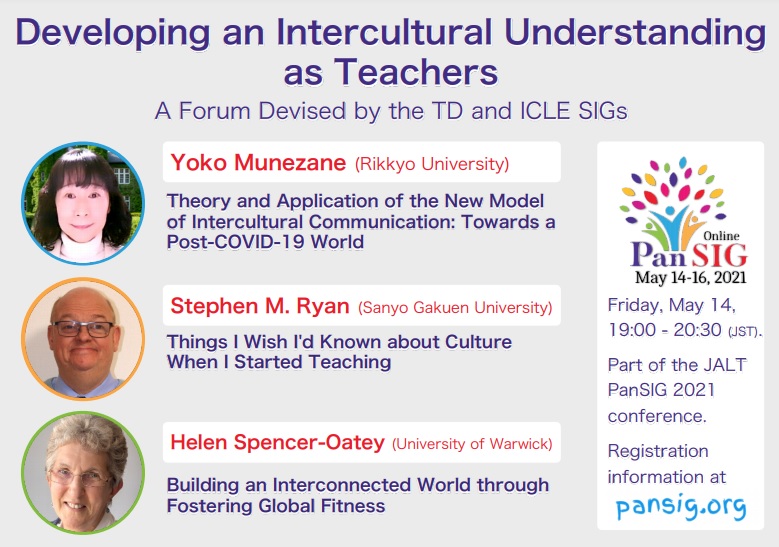


Yoko Munezane
 introduced a new empirical model of intercultural communicative competence, exploring the structural relationships among eight individual differences factors, and how this model could be applied to the language classroom to promote intercultural friendship.

Following this, Stephen Ryan provided lessons learnt through an autobiographical presentation outlining the evolution of his understanding and approaches to the position of culture in his teaching.

Finally, Helen Spencer-Oatey demonstrated ways we can learn to notice how socialisation-based multiple identities affect behaviour, through reflecting on their potential significance and seeing what impacts they have on our (mis)evaluations of others. 

Following the series of presentations, an engaging discussion took place in which the speakers reflected on each other’s talks, established points of resonance, and developed some new ideas together. The TD SIG would like to thank you if you attended this forum.
TD & CUE SIG Forum @ JALT2020

On Saturday, November 21 at the JALT2020 conference, the TD and CUE SIGs held their tenth joint forum, “Forms and Functions of Community in Education”.

The forum was conducted online via Zoom, and the format was slightly different from past years. Five members from the SIGs spoke in turn about their experiences in creating community.

First, Mathew Porter of Fukuoka Jo Gakuin Nursing University described a community among nurse educators in a nursing department at a Japanese university. Wendy Gough of Bunkyo Gakuin University spoke about the importance of mentors, and how to find or become one. Peter Brereton of International Christian University shared his experience in establishing a group of reflective practitioners which helped to more deeply connect his university with its associated high school. Daniel Hooper of Kanda University of International Studies shared the importance of action logs in adjusting to a new community during his transition from a small eikaiwa to a private international university. Dawn Lucovich of Nagano JALT and The University of Nagano spoke about the principles necessary to create a community of practice and how they can be implemented at JALT.

After the presenters spoke, there was a brief moderated discussion in which participants discussed in breakout groups how they might implement the ideas expressed to foster community in their own teaching contexts, and then shared some final thoughts with the full group. Please look forward to more collaboration with the CUE SIG on future forums!

Report of ‘Using Video in Language Teacher Education’ Forum

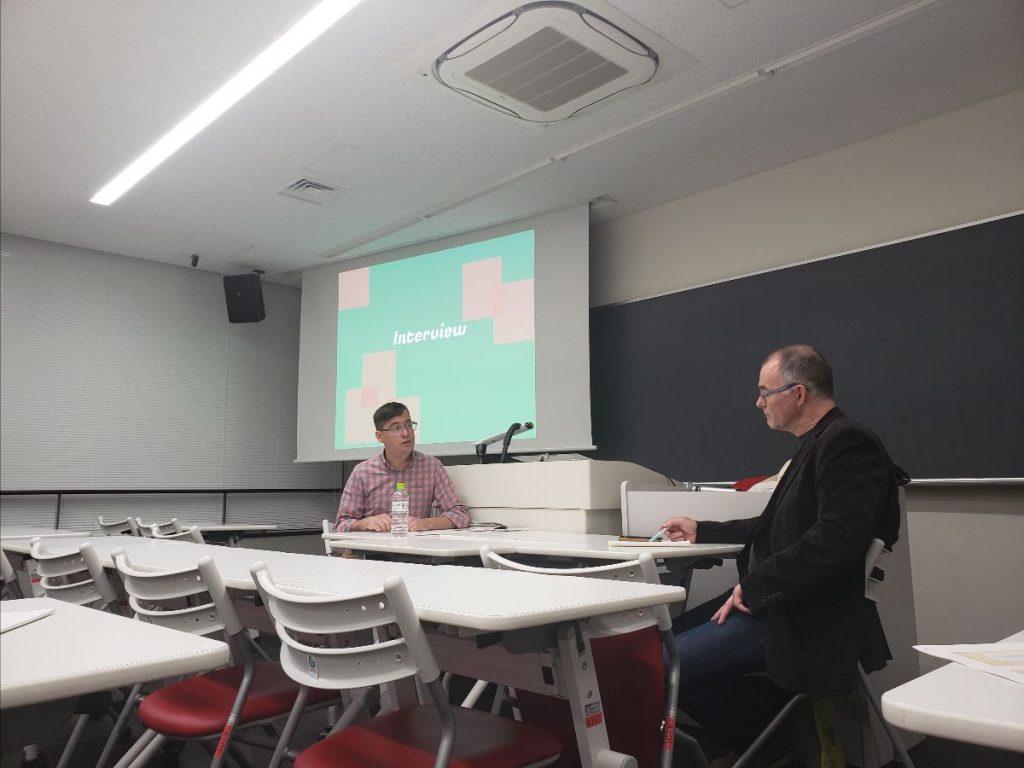
On Tuesday, December 3, the TD SIG hosted a forum titled – Using Video in Language Teacher Education. The forum took place at Toyo University in Tokyo and was attended by approximately 15 people from a variety of different teaching contexts. The forum featured three speakers, Dr. Steve Mann from the University of Warwick, Robin Skipsey from the British Council, and Davey Young from Rikkyo University.

Dr. Mann opened the forum with a presentation that provided an overview of video uses for teacher development, and he gave some examples of different tools that could be used for implementing video projects. Following this, Robin Skipsey introduced the audience to a British Council project in which video was part of a cascade teacher training model. Robin talked about how trainee teachers used video to reflect on their own teaching practices, try new activities in their classrooms, and pass on useful approaches to others.

The final presentation saw Davey Young talk about how lesson observation videos are used to maintain quality assurance in a unified course at Rikkyo University. Through making recordings of lessons, both teachers and program managers were able to collaboratively assess how objectives were being met, for example.
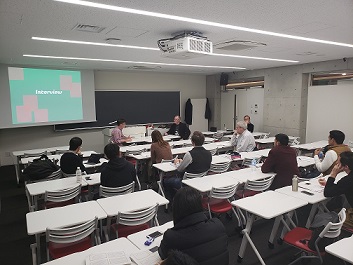
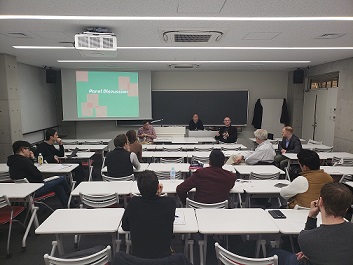

As well as presentations, the forum also featured interviews. The TD SIG’s coordinator Matthew Turner asked questions to Robin about the content of his presentation, with Steve asking questions to Davey about his talk. Through the interviews, both the audience members and participants were able to interactively explore themes in more detail. The forum culminated in a discussion between the panel, led by questions from the audience.

Understanding Language and Learning: Theoretical, Methodological, and Cultural Developments in Applied Linguistics

On Friday, 19 July, professor Nick Ellis from the University of Michigan delivered a talk titled
Understanding Language and Learning: Theoretical, Methodological, and Cultural
Developments in Applied Linguistics, at Rikkyo University in Tokyo. The event was hosted by
JALT’s Tokyo chapter, and we were happy to co-sponsor the event alongside the West Tokyo
and Yokohama chapters. Professor Ellis is an esteemed and notable scholar in the field of
cognitive linguistics, as well as other related areas, and opened his presentation by taking
the audience on a journey through his lengthy career. Professor Ellis then described
important changes, trends and insights regarding second language acquisition research, and
their implications for researchers and research. Focussing primarily on quantitative studies
into cognition and language learning throughout his talk, professor Ellis concluded by
discussing the expectations of scholars currently working in the field, by explaining about
the open access and open data movements in modern academia, and the increasingly
demanding rigours of conducting reliable, significant and empirically sound studies.
Professor Ellis also talked about some of the figures in our field who are best placed to
bridge the gap between researchers and teachers, and also offered some ideas on potential
areas that need further investigation and research. We would like to thank Nick for his
presentation, the hosts at Rikkyo university, as well as the three chapters who co-sponsored
this event.

Teacher Journeys x SUTLF 2019


This year marked the eighth annual Teacher Journeys Conference, and the Teacher Development SIG, in collaboration with the JALT NanKyu Chapter, organised the Teacher Journeys x SUTLF Conference. The conference was held on Saturday, June 29th at Sojo University in Kumamoto, and was housed inside the recently built Sojo International Learning Center (SILC). The aim of the conference was to explore the winding but meaningful paths teachers take towards greater self-awareness and improved classroom practices.

The featured speakers were Christopher Hale of Akita International University and Fumi Takegami of the Prefectural University of Kumamoto. They spoke on the topics: ‘Educating the Educators: Exploring the Experiences of Teachers Enrolled in an American TESOL Program in Japan’ and ‘Reconceptualizing Practice: Implications for Teacher Development’, respectively.


Through the combined efforts of the day’s many presenters, conference attendees learnt about varying aspects of English pedagogy, the efforts teachers make in the classroom, the challenges they face and overcome, and how their varied encounters impact their professional aspirations and students’ motivation. The evening culminated in a networking dinner with the organisers, presenters and conference attendees.

The Teacher Development SIG and JALT NanKyu would like to thank all our presenters, invited guests, host (Sojo University), and the conference attendees for coming and taking part. To our members: thank you for your continued support. We are look forward to seeing you again at JALT National!

Teacher Identity and Emotions

On Wednesday, March 20th, the Teacher Development SIG hosted a workshop on Teacher Identities and Emotions in partnership with Rikkyo University. Sam Morris of Kanda University of International Studies first spoke on“Frustration Regulation in Japanese University English Language Teaching”. Through group discussion, he led the audience to understand the meaning of frustration and its negative and positive roles in teaching. He also outlined in detail several strategies to deal with frustration when such feelings arise.

Next, Christina Gkonou of the University of Essex delivered a talk entitled“Understanding Shifts in Language Teacher Identities and Emotions”. She outlined the relationship between our students, our colleagues, and ourselves with our identities as teachers as a central hub. Christina shared the important message that emotion and identity are not formed personally within ourselves, but socially and dynamically in our greater teaching contexts. The sessions lasted approximately three hours in total, and were attended by about 30 people.

The Teacher Development SIG would like to thank Christina and Sam, along with Rikkyo University for such an engaging event! Check out their talks below. 

Sam Morris – Frustration regulation and language teaching (PowerPoint slides)

Dr Christina Gkonou – Understanding shifts in language teacher identities and emotions (PowerPoint slides)

Teacher Journeys 2018

Teacher Journeys 2018 and Call for Co-Sponsors Next Year

On Sunday June 3, TD held its biggest annual event, Teacher Journeys, at Rikkyo University with co-sponsors Tokyo JALT. The conference was attended by about 50 people, and featured plenary talks by Dr. Christina Gkonou of the University of Essex, and Dr. Tomohisa Machida of Akita International University, along with sixteen presentations in four sessions throughout the day. Look forward to proceedings of the conference to be published in ETD in the coming months.

Currently we are looking for chapters to partner up with for Teacher Journeys 2019. Please get in touch with program chair Mike Ellis (maikeru.desu@gmail.com) if you’d like to bring the conference to your area next year.